

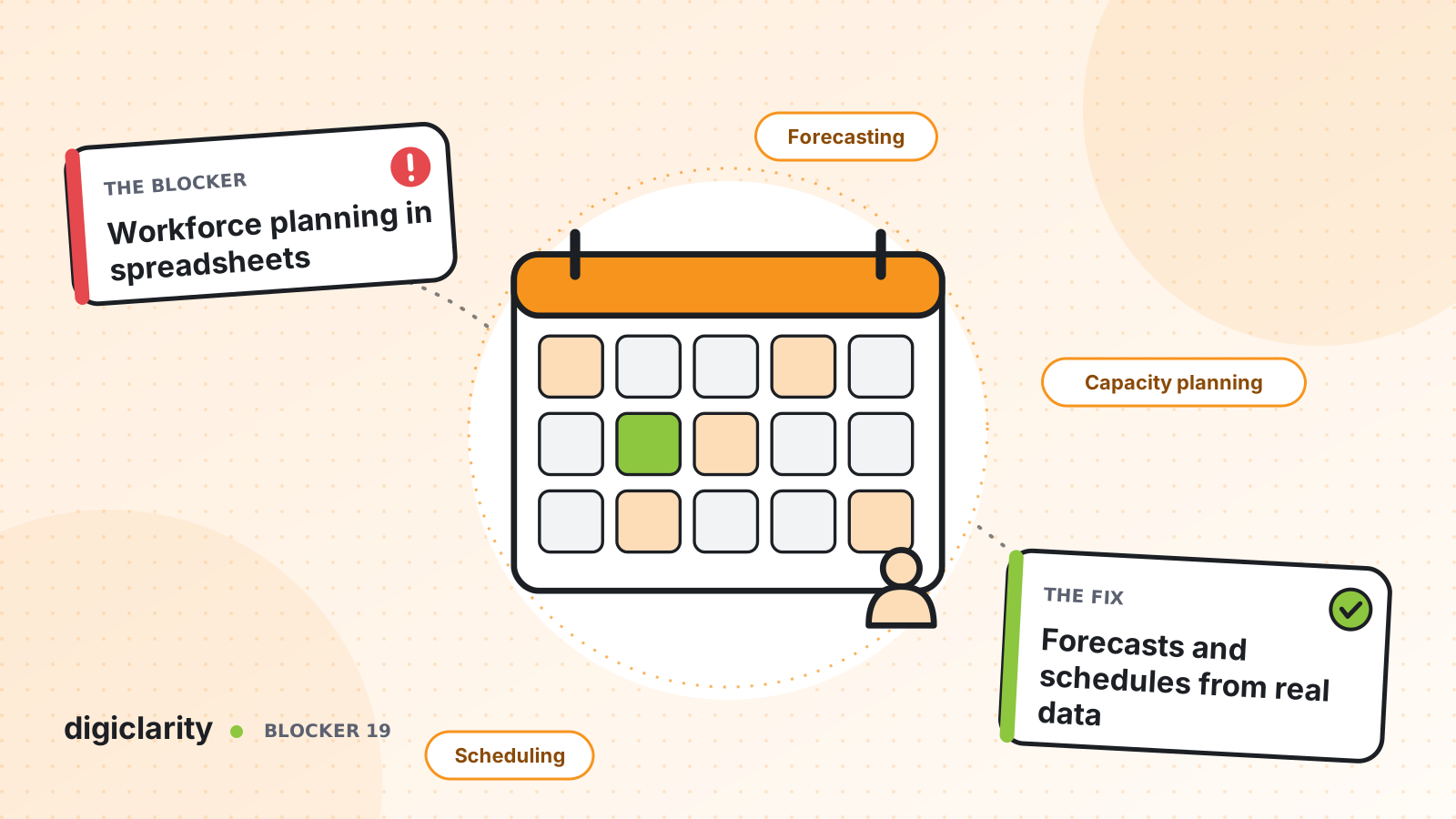
The blocker
Every week, someone exports last month’s call data, pastes it into a workbook, adjusts a few formulas and produces a forecast. Another tab turns it into headcount. Another turns headcount into shifts. Time-off requests arrive by email and are typed in by hand. When the person who built the workbook is on vacation, nobody wants to touch it.
The cost shows up in two places. On busy days the queue is understaffed, waits grow and customers hang up. On quiet days agents sit idle and the business pays for time it did not need. AWS notes that people are often the largest cost of a contact center, so even small planning errors are expensive.
Why it happens
- The data is always old. A spreadsheet forecast is only as fresh as the last export.
- Averages hide the shape of the day. Daily or weekly totals miss the peaks within an hour.
- Plans and schedules live apart. Hiring, scheduling and real-time management use different files and different numbers.
- Nobody can see adherence. Supervisors cannot tell, in the moment, who is off schedule.
- Agents depend on email. Shift swaps and time off go through a manager’s inbox.
How Amazon Connect solves it
Amazon Connect includes forecasting, capacity planning, scheduling and schedule adherence, built on the contact data the platform already records. AWS describes these as machine learning powered services for getting the right number of agents working at the right times.
1. Forecasts that update themselves
Amazon Connect forecasting predicts contact volume and average handle time from historical metrics. Forecasts refresh on their own:
- Short-term forecasts update daily and are used for scheduling up to 18 weeks ahead.
- Long-term forecasts update weekly and are used for capacity planning up to 64 weeks ahead.
- Intraday forecasts update every 15 minutes, for queues that meet the volume thresholds AWS documents.
AWS lists the data requirements, and recommends at least 1,000 contacts per month over the last six months in a forecast group for accuracy. If you are new to Amazon Connect, you can import historical data from your previous system. Imported data can also correct unusual days, such as an outage.
2. Capacity plans that finance can use
Capacity planning turns forecasts into staffing targets. A Hiring plan estimates long-term FTE needs up to 64 weeks out, which you can share with HR, Finance and Training. A Scheduling plan shows headcount needed in 15- or 30-minute intervals, so you can find gaps in the weeks ahead. You can add scenario inputs such as shrinkage to make the plan more accurate.
3. Schedules generated, not typed
Scheduling builds agent schedules from a published short-term forecast, shift profiles, staffing groups and your HR and business rules. When you generate a schedule, you choose an optimization goal per channel, such as service level or average speed of answer, and Amazon Connect aims for the fewest shifts that meet it. AWS notes that scheduling is not designed to ensure compliance with any particular law, so check employment rules with your own advisors.
Agents view their schedule in the agent workspace. They can request shift exchanges from their calendar, with manual or automatic approval, and submit time off that is approved or rejected against the rules you configure.
4. Adherence you can see as it happens
Once schedules are published, Amazon Connect tracks schedule adherence by comparing each agent’s status with their scheduled activity. Real-time adherence appears in the real-time metrics agent schedule adherence table and in the Queue and agent performance dashboard, refreshing within a few minutes. The Intraday forecast performance dashboard compares the day’s actuals with the forecast, so supervisors can react before the afternoon peak.
What good looks like
The forecast is ready when planners arrive, built from last night’s data. Capacity plans and schedules use the same numbers. Agents see their shifts, trade them and request time off without email. Supervisors watch adherence and intraday performance on one screen. The spreadsheet is retired, and the plan no longer depends on one person.
The conversation with finance changes too. Instead of a headcount request backed by last year’s averages, the workforce team brings a hiring plan built from a long-term forecast, with the shrinkage and service level assumptions written down. When volume shifts, the forecast updates on its own, and the plan can be re-run rather than rebuilt by hand.
Where to start
- Check how much contact history you have in Amazon Connect, and export more from your old system if it is under a year.
- Set up one forecast group for your highest-volume queues and review its forecast against last month.
- Model your shifts, rules and shrinkage, and run a scheduling plan for the next few weeks.
- Publish a schedule for one team, turn on adherence, and expand once supervisors trust it.