
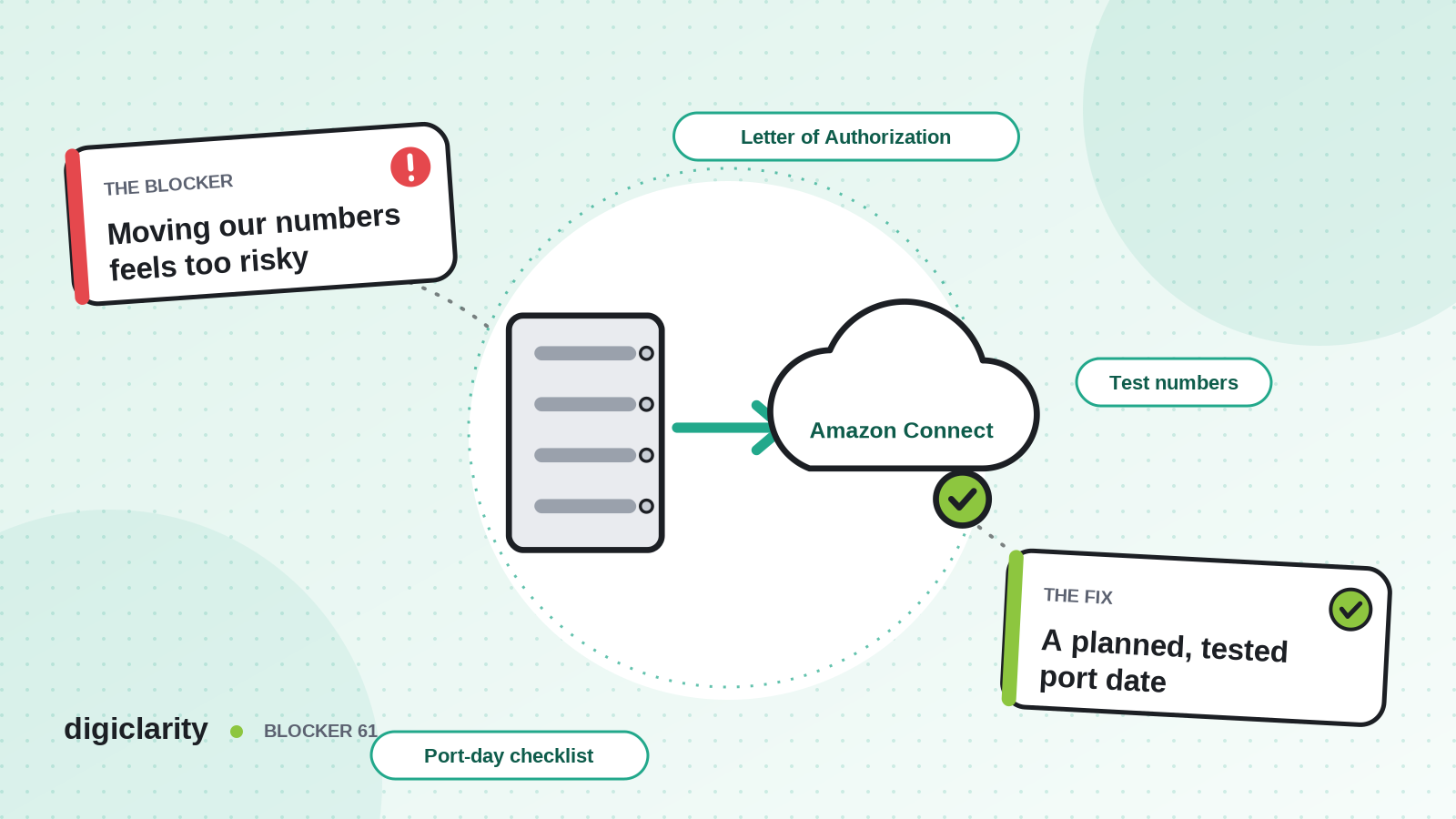
The blocker
The new contact center is built and tested. Then someone asks about the phone numbers. The main number is on the website, printed on every bill and saved in customers’ phones. Nobody wants to change it, and nobody wants to be the person who loses it.
So the move stalls. Teams worry about the day calls stop arriving, about paperwork the old carrier might reject, and about having no way back. Some plan to run the old platform “for a while longer”, which turns into another year of paying for two systems.
Why it happens
- Nobody owns the number inventory. Numbers sit with several carriers, some under old contracts or another provider’s account.
- The paperwork is unfamiliar. Carriers reject requests over small mismatches, and each rejection resets the clock.
- Timelines are underestimated. Teams plan weeks for a process that can take months outside North America.
- The port is treated as the test. Flows are first tested with real customers on port day.
- Rollback is assumed. Teams expect to “switch back” without knowing what that takes.
How Amazon Connect solves it
AWS now calls the contact center product Amazon Connect Customer, and the documentation linked here uses that name. AWS publishes a full number porting guide, including the terms to know: your current carrier is the losing carrier, the carrier for Amazon Connect is the winning carrier, and the Letter of Authorization (LOA) is the document that gives permission to move the number. Porting is run through AWS Support, which works with the carriers for you.
1. Know what porting involves, and what it costs
AWS explains in What does it mean to port phone numbers that the losing carrier removes your number, the winning carrier adds it, and routing is updated. Most porting activities complete within 15 to 30 minutes, with possible call disruptions. Most losing carriers port only during normal business hours, and carriers typically set a two-hour porting window.
Amazon Connect does not charge fees for porting, though your current carrier might charge for disconnection or early termination. Not every number can move. Which numbers can be ported depends on country rules, carrier agreements, number type and your contract. Numbers bought from another contact center provider can usually be ported, but confirm with that provider who holds the assignment. If you port only part of a number block, you stay liable for the rest with your old carrier.
2. Start early, especially outside North America
AWS asks you to start several months before go-live. Numbers in the US and Canada typically take two to four weeks once portability is verified and documents are submitted correctly. Numbers outside the US and Canada take two to six months. One exception cuts the other way: porting requests for US DID and toll-free numbers cannot be submitted more than 30 days before the porting date.
Requests for more than 10 distinct number ranges or 10 distinct locations are treated as a project, with their own timeline and coordination through your AWS account team. Each country has its own documents and porting windows, listed in Region requirements for ordering and porting phone numbers. For example, the US window is Monday to Friday, 07:00 to 17:00 CST. UK local numbers port Monday to Friday, 09:00 to 11:00 GMT.
3. Get the paperwork exactly right
The porting steps start with a support case for each set of numbers from a different carrier or country. The case includes your instance ARN, the numbers in E.164 format, the exact name of the flow each number should map to, and your preferred date and time.
The LOA is where most delays come from. It must match the carrier’s Customer Service Record exactly, carry a handwritten “wet” signature, be dated within the last 15 days, and list numbers from only one carrier and country. Up to 10 toll-free numbers can be listed on the LOA, with a spreadsheet for more. Do not attach personal documents to the case. AWS Support sends a secure upload link that expires after ten days. Answer requests quickly: if you take longer than 30 days, the request might be cancelled or restarted.
4. Test the flows before the numbers move
AWS recommends that you test your flows before the port date by claiming a DID or toll-free number in Amazon Connect and attaching it to the flow. You can claim numbers in the admin website or with the ClaimPhoneNumber API, then release them when you are done. You pay the daily number rate and telephony minutes until you release it. Released numbers cannot be claimed again. We covered test coverage for flows in untested flows.
About 3 to 4 days before the agreed date, AWS Support loads the numbers into your instance. You check they are listed and attach each one to its flow. AWS also asks for any service quota requests, such as concurrent calls, at least five days before the date. Our peak day service quotas post explains which quotas matter.
5. Run port day from a checklist, and plan your way back
On the day, AWS’s checklist is to confirm the numbers and flows, watch traffic stop on the old platform, place test calls, make sure agents are logged in, and watch traffic arrive in Amazon Connect. AWS notes that in rare cases it can take several hours for routes across all carriers to update. If calls do not arrive after the window, update your support case and AWS works with its carrier.
Be realistic about rollback. AWS needs at least 5 business days’ notice to cancel or reschedule a port that has not happened. After a port completes, moving the number back needs a new LOA and documents. So the practical rollback is inside Amazon Connect. Keep the old platform running, reachable on a separate number, and prepare a flow that sends callers there with the Transfer to phone number block. If something goes wrong, you switch the ported number to that flow. And as AWS says, do not cancel your old service until the numbers are ported and confirmed working, or you might lose them. Porting usually sits inside a wider move, covered in a phased migration to Amazon Connect.
What good looks like
The number inventory is complete months ahead. LOAs are accepted the first time. Flows have run for weeks on test numbers. On port day, the team watches calls leave the old platform and arrive in Amazon Connect within the window, with agents logged in and a fallback flow ready. The old contract ends only after every number is confirmed working.
Where to start
- List every number by country, carrier, type (DID or toll-free) and the flow it should reach.
- Get your latest bill or Customer Service Record from each carrier and check the details against your LOA.
- Open a support case per carrier and country, as early as the timelines allow.
- Claim test numbers and test every flow, then request any quota changes.
- Write the port-day checklist and fallback flow, and keep the old service until each number is confirmed.